



Ocean Currents Map & Plastic Pollution Map: How Currents Move Marine Debris

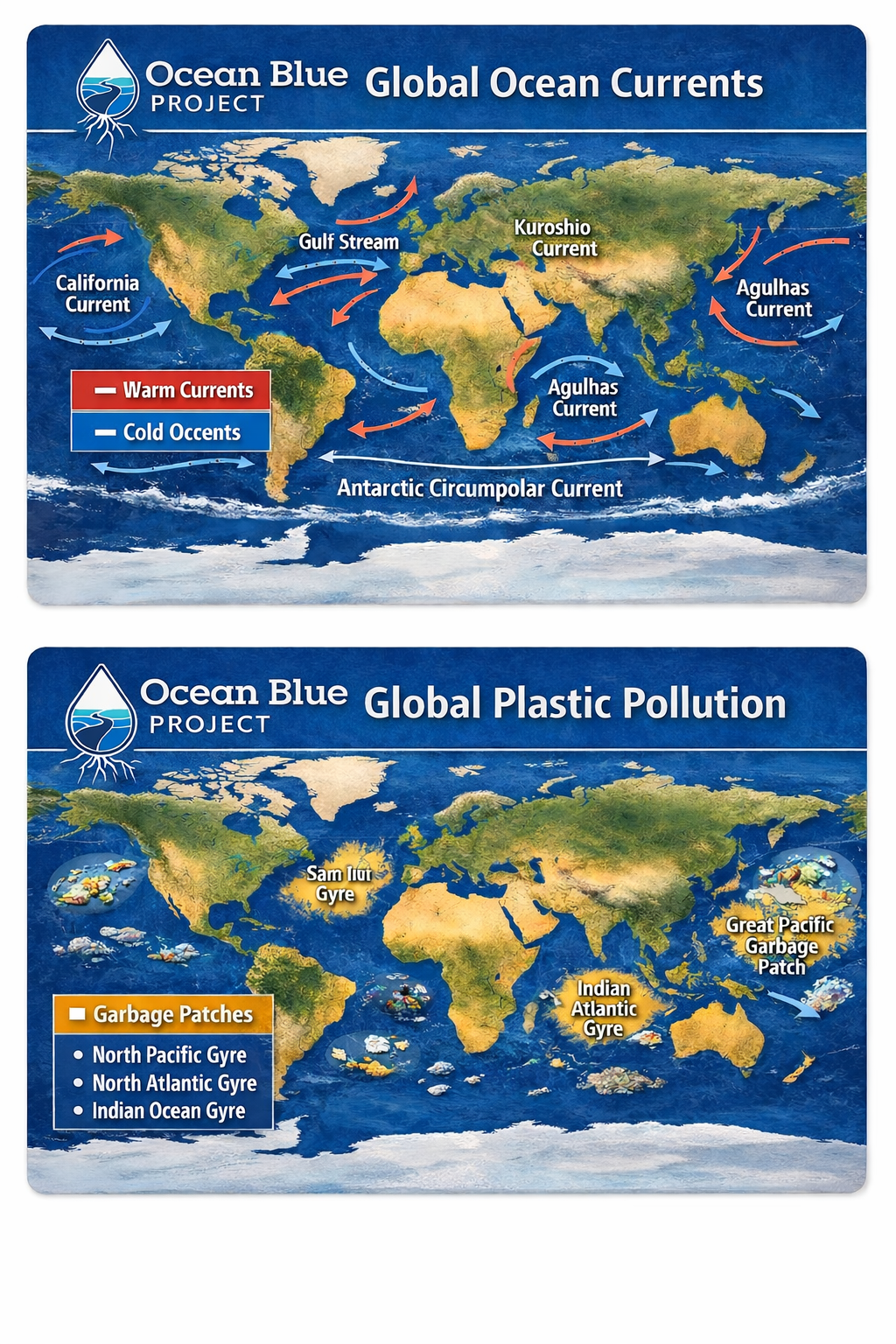
An Ocean Currents Map does more than show moving water — it reveals the pathways that transport plastic pollution across the globe. When paired with a plastic pollution map, we can see how floating debris travels thousands of miles, accumulates in ocean gyres, and impacts coastlines far from its source.
Understanding how ocean currents move plastic is essential for predicting debris pathways, protecting marine ecosystems, and targeting effective cleanup efforts.
What an Ocean Currents Map Shows


An Ocean Currents Map illustrates the major surface and deep circulation patterns that move water around the planet. These currents are driven by:
-
Global wind systems
-
Earth’s rotation (Coriolis effect)
-
Temperature differences
-
Salinity (salt concentration)
-
Seafloor and coastal features
Surface currents, powered primarily by wind, are especially important for understanding plastic movement because most marine debris floats.
Major current systems shown on an Ocean Currents Map include:
-
The Gulf Stream
-
The Kuroshio Current
-
The California Current
-
The North Equatorial Current
-
The Antarctic Circumpolar Current
Together, these currents connect ocean basins into one global circulation system.
How Ocean Currents Move Plastic Pollution
Once plastic enters the ocean — through rivers, coastal runoff, fishing activity, or storm events — it becomes part of this moving system.
Because plastic is lightweight and buoyant, it is transported by wind-driven surface currents. Over time, debris travels across entire ocean basins.
An Ocean Currents Map helps explain:
-
Why plastic from one continent can wash ashore on another
-
How debris accumulates in mid-ocean regions
-
Why certain coastlines experience repeated pollution events
Currents do not create plastic pollution — but they determine where it collects.
Ocean Gyres: The Link Between Ocean Currents and Plastic Pollution Maps
Large circular current systems called gyres play a critical role in plastic accumulation.
There are five major subtropical gyres:
-
North Pacific Gyre
-
South Pacific Gyre
-
North Atlantic Gyre
-
South Atlantic Gyre
-
Indian Ocean Gyre
On an Ocean Currents Map, gyres appear as massive rotating systems. On a plastic pollution map, these same areas often show high concentrations of debris.
The most well-known example is the Great Pacific Garbage Patch, located within the North Pacific Subtropical Gyre. Here, circulating currents continuously funnel plastic into a relatively calm central zone, where it accumulates over time.
From Surface Plastic to Microplastics
Plastic pollution does not remain intact forever. Sunlight, wave action, and physical abrasion break larger debris into smaller fragments known as microplastics.
As pieces become smaller, they can:
-
Remain suspended near the surface
-
Sink into deeper water layers
-
Enter marine food webs
Deep ocean circulation — driven by temperature and salinity differences — can transport microplastics far below the surface. This means plastic pollution is not only visible on the surface; it can spread throughout the entire water column.
Why Some Coastlines See More Plastic Than Others
Ocean currents help explain why certain regions experience heavier plastic accumulation.
Seasonal wind shifts, storm systems, and current direction can push debris toward specific coastlines. Areas located downstream of major current systems are often more vulnerable to repeated pollution events.
By comparing an Ocean Currents Map with a plastic pollution map, researchers can identify:
-
High-impact cleanup zones
-
Vulnerable marine ecosystems
-
Areas where prevention efforts are most urgent
How Ocean Currents Influence Cleanup Strategy
Understanding ocean circulation improves the effectiveness of plastic removal efforts.
Mapping current patterns helps organizations:
-
Predict debris movement
-
Intercept pollution before it enters open ocean gyres
-
Focus on high-accumulation zones
-
Plan coastal cleanup operations
Rather than reacting randomly, cleanup strategies can be informed by circulation science.
The Bigger Picture: One Connected Ocean
Ocean currents connect every coastline into a single, global system. Plastic entering the ocean in one location may travel across continents within years.
An Ocean Currents Map shows how water moves.
A plastic pollution map shows where debris accumulates.
Together, they reveal the interconnected nature of marine pollution — and the importance of coordinated global solutions.
Understanding how ocean currents move plastic pollution is essential for climate science, marine conservation, and restoring ocean health for future generations.

