
Ocean Currents Map: Global Ocean Circulation Explained
Why are Ocean Currents Important?
Types of Ocean Currents: Surface and Deep Circulation
An ocean currents map shows more than just moving water — it reveals how debris, including plastic pollution, travels across the world’s oceans. Ocean currents are driven by wind, tides, and differences in water density. Together, they form a global circulation system that regulates climate, supports marine ecosystems, and unfortunately, transports floating plastic across entire ocean basins. Understanding how currents move helps explain why plastic pollution found on one coastline may have originated thousands of miles away. Wind-Driven Surface Currents and Floating Plastic When viewing a global ocean currents map, the most visible patterns are surface currents. These are powered by global wind systems that push water across the ocean’s surface. Because plastic floats, it moves with these surface currents. Major current systems — such as the Gulf Stream in the Atlantic or the Kuroshio Current in the Pacific — can carry debris long distances. Over time, plastic accumulates in large circular current systems known as gyres. These gyres create areas of concentrated marine debris, often referred to as garbage patches. Surface currents are not just lines on a map — they are pathways that determine where pollution travels and where it collects. Ocean Gyres: Where Plastic Accumulates On an ocean currents map, you can identify five major subtropical gyres: North Pacific Gyre South Pacific Gyre North Atlantic Gyre South Atlantic Gyre Indian Ocean Gyre These rotating systems trap floating debris. As currents circulate continuously, plastic becomes concentrated in the center of these gyres. Because plastic breaks into smaller pieces rather than fully biodegrading, it remains within circulation systems for decades. Deep Ocean Circulation and Microplastics While surface currents transport visible debris, deeper circulation patterns also play a role. Thermohaline circulation — driven by temperature and salinity differences — moves water vertically and horizontally across ocean basins. Over time, microplastics can sink and become distributed through deeper ocean layers. This means plastic pollution is no longer just a surface issue. It becomes embedded in marine ecosystems at multiple depths. Why Understanding Ocean Currents Matters for Cleanup Efforts An ocean currents map helps scientists and environmental organizations predict: Where plastic will accumulate Which coastlines are most vulnerable How debris travels after storms Where cleanup efforts will have the greatest impact By studying circulation patterns, nonprofits can target high-impact cleanup zones and intercept debris before it spreads further into open ocean systems. Ocean currents connect every coastline. Pollution entering the ocean in one region can eventually affect marine life and communities far away. The Bigger Picture Ocean currents regulate Earth’s climate, transport nutrients, and support biodiversity. But they also reveal the global scale of plastic pollution. A detailed ocean currents map shows us that the ocean is not divided by borders — it is one interconnected system. What enters the water in one place can travel across continents. Understanding these patterns is essential not only for climate science, but for protecting marine life and restoring ocean health.
Download the Ocean Currents Map PDF: Global Circulation & Major Gyres


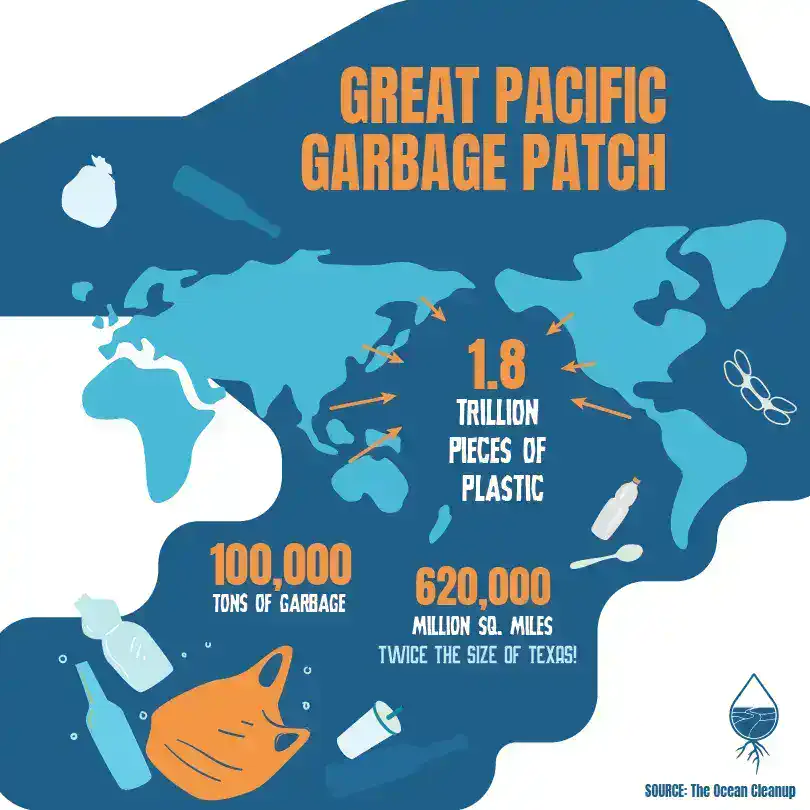
The Great Pacific Garbage Patch and Ocean Currents
How Did Ocean Currents Create the Great Pacific Garbage Patch? The Great Pacific Garbage Patch formed because rotating ocean currents in the North Pacific Subtropical Gyre trap floating plastic debris. Four major currents — the California Current, North Equatorial Current, Kuroshio Current, and North Pacific Current — circulate continuously, funneling trash into a calm central zone where it accumulates. Where Is the Great Pacific Garbage Patch Located? The Great Pacific Garbage Patch is located in the North Pacific Ocean, between Hawaii and California. It sits within the center of the North Pacific Subtropical Gyre, a large circular system of ocean currents that traps floating debris. What Causes Plastic to Accumulate There? Plastic builds up in the Great Pacific Garbage Patch because: Surface currents carry floating debris across the Pacific Ocean The gyre rotates clockwise, pulling trash inward The center of the gyre has relatively calm waters Plastic breaks into microplastics instead of biodegrading This continuous circulation allows debris to remain trapped for decades. What Is the North Pacific Subtropical Gyre? The North Pacific Subtropical Gyre is a large clockwise-rotating system of ocean currents formed by global wind patterns and Earth’s rotation. It is made up of four main currents: California Current North Equatorial Current Kuroshio Current North Pacific Current Together, these currents create the circulation pattern responsible for concentrating plastic in the Great Pacific Garbage Patch.
To Understand Ocean Currents, it's best to start with understanding the waves. and how it plays a large role in creating energy.
To understand ocean currents, it helps to begin with ocean waves and how energy moves across the surface of the sea. Ocean waves are created primarily by wind transferring energy to the water. As wind blows across the ocean’s surface, it generates movement and motion that can travel long distances. While waves and ocean currents are not the same thing, both are driven by energy from wind and are influenced by Earth’s rotation and gravitational forces. Waves represent the movement of energy through water, while ocean currents represent the large-scale movement of the water itself. Understanding how energy is transferred at the ocean’s surface provides a foundation for understanding how surface currents form and how global ocean circulation develops. In short, waves help illustrate how wind energy interacts with the ocean — a key factor in driving surface currents shown on an ocean currents map.
Connected One World Ocean
How Ocean Currents Affect Marine Life
How Ocean Currents Affect Marine Life Ocean currents exist both at the surface and deep below it. Some currents are local, influencing coastal regions, while others operate on a global scale and connect entire ocean basins. Together, these currents move enormous volumes of water around the planet. The largest ocean current in the world is the Antarctic Circumpolar Current (ACC). This powerful current flows eastward around Antarctica and is estimated to transport nearly 100 times more water than all of the world’s rivers combined. Its scale demonstrates how significant ocean circulation is in shaping global marine systems. How Currents Transport Nutrients As ocean currents move, they carry nutrients, oxygen, and organic matter throughout the water column. This circulation is critical for marine ecosystems. Many stationary or slow-moving marine organisms — such as corals, sponges, and shellfish — rely on currents to deliver food directly to them. Rather than actively searching for nutrients, these species depend on steady water movement to supply plankton and other microscopic food sources. Upwelling currents are especially important. In these regions, deep, nutrient-rich water rises to the surface, supporting productive fisheries and dense marine biodiversity. Ocean Currents and Reproduction Ocean currents also play a major role in marine reproduction. Many species release eggs, larvae, or reproductive cells into the water column. Currents then transport these larvae across vast distances. This dispersal helps: Expand species populations Maintain genetic diversity Recolonize damaged habitats Connect distant ecosystems Without ocean currents distributing nutrients and reproductive material, many marine ecosystems would struggle to survive. Coral reefs, kelp forests, and open-ocean food webs all depend on continuous water movement. Why This Matters Ocean currents are not just moving water — they are life-support systems for the ocean. From the Antarctic Circumpolar Current to small coastal flows, circulation patterns regulate food supply, biodiversity, and ecosystem resilience. Understanding how ocean currents function helps explain why protecting ocean health is essential for maintaining global marine life.

What Can You Do?
Cleaning up the Great Pacific Garbage Patch is a challenge. It is not close to any coastline, which means no one country or organization has stepped up to take responsibility for its cleanup. However, many ocean conservation organizations, such as Ocean Blue Project, one of the best Ocean cleanup organizations removing 1 million pounds of plastic by 2025. Help save our blue economy by making a one time donation to help remove plastic pollution from a beach near you.
The best way to support this effort — reduce your use of single-use plastics. If less plastic is being used, then less of it will end up in our oceans.
What are the Five Oceans of the World?
"The Five bodies of water and the global ocean produces more then half oxygen humans breath."
Antarctic Ocean
The Southern Ocean also known as the antarctic area.
The Antarctic ocean is the smallest of our oceans and the fourth largest and is full of wildlife and mountains of ice lastly throughout the year. Although this area is so cold humans have managed to live here. One of the largest setbacks is with global warming most of the ice mountains is expected to melt by 2040. The depth of The Antarctic Ocean is 23,740′ in depth. The Southern Ocean also known as the Antarctic Area: 7.849 million mi².
How many people live in the Antarctic? No humans live in Antarctica permanently, but around 1,000 to 5,000 people live through the year at the science stations in Antarctica. The only plants and animals that can live in cold live there. The animals include penguins, seals, nematodes, tardigrades and mites.
Indian Ocean
Fun facts: Between Africa and Austral
Indian Ocean is located between Africa and Austral-Asia and the Southern Ocean. is the third largest of our oceans and covers a fifth ( 20%) of our earths surface. Until the mid 1800s the Indian Ocean was called the Eastern Oceans. The Indian Ocean is around 5.5 times the size of United States and is a warm body of water depending on the Ocean Currents of the Equator to help stabilize the temperatures.
Atlantic Ocean
Atlantic Ocean boards North America, Africa, South America, and Europe. This Ocean is the second largest of our five oceans and home of the largest islands in the world. The Atlantic Ocean covers 1/5 of the earths surface and 29% of the waters surface area.
The Atlantic Ocean ranks the second for the most dangerous ocean waters in the world. This ocean water is usually affected by coastal winds, temperature of the water surface currents maps.
6 Types of Plants That Live in the Atlantic Ocean
- Kelp. Kelp grows in cold coastal waters. …
- Seaweed. …
- Seagrass. …
- Red Algae. …
- Coral and Algae. …
- Coralline Algae.
Pacific Ocean
Pacific Ocean Temperatures or conditions are split: cold in east, and warmer in west. In Oregon the body of water is average 54 degrees. Winter has huge Oregon King Tides leaving the norther waters super rough seas.
Fun Facts For Youth:
Atolls are in the warmer conditions of the Pacific Ocean and are the Coral Sea Islands West of the Barrier Reef in Australia. Atolls are only found in the warm ocean waters, located in the southern water bodies of our ocean.
Ocean Plastic
The Pacific Ocean is also the home for the most micro plastics floating in our oceans. The plastic are caused by humans littering by accident or just littering. Plastic pollution makes its way to the ocean in many directions by getting into street drains, rivers, blowing in the wind, or from fishing boats. learn about how some animals help lower plastic pollution.
6 Types of Plants That Live in the Pacific Ocean
- Kelp. Kelp grows in cold coastal water bodies.
- Seaweed
- Seagrass
- Red Algae
- Coral and Algae
- Coralline Algae

How do Ocean Currents affect Climate
How Ocean Currents Affect Climate, Weather, and Marine Life
Ocean currents move warm water toward the polar regions and cold water toward the tropics, helping regulate Earth’s climate and regional temperatures. By redistributing heat across the planet, ocean circulation influences weather systems, storm development, and long-term climate patterns.
To better understand how global circulation works, explore our detailed [Ocean Currents Map guide].
Understanding ocean currents also helps explain how pollution travels across ocean basins. Learn how debris moves through circulation systems in our article on [How Ocean Currents Move Plastic Pollution].
What Are Ocean Currents?
Ocean currents are continuous, directed movements of seawater that flow across the surface and through the deep ocean. These powerful systems shape climate, support marine ecosystems, and even influence the seafood we rely on.
Currents form due to several interacting forces, including:
Wind
Tides
Differences in water density (temperature and salinity)
Earth’s rotation (Coriolis effect)
Coastal and seafloor features
If you’re new to the topic, start with our overview: [What Drives Ocean Currents?]
Together, these factors create a complex global circulation system that connects every coastline.
Surface Currents: Driven by Wind and Tides
Surface currents are primarily driven by prevailing global winds. As wind blows across the ocean’s surface, it transfers energy to the water, setting it in motion.
These surface flows are clearly visible on an ocean currents map and are responsible for transporting floating debris long distances. For a deeper dive, see our breakdown of [Wind-Driven Surface Currents Explained].
Surface currents influence:
Weather patterns
Storm intensity
Maritime trade routes
Coastal water temperatures
They also guide marine species migration and help distribute nutrients that sustain fisheries. Read more about this in [How Ocean Currents Affect Marine Life].
What Causes Deep Ocean Currents?
Deep ocean currents are driven by differences in water density — a process known as thermohaline circulation.
Water density changes based on:
Temperature (colder water is denser)
Salinity (saltier water is denser)
In polar regions, cold and salty water sinks, initiating deep circulation that forms part of the global ocean conveyor belt.
We explain this system in detail in [Thermohaline Circulation and Global Climate].
These deep currents regulate global temperatures and transport oxygen and nutrients to deep-sea ecosystems.
How Earth’s Rotation and Seafloor Shape Currents
Ocean currents are also shaped by the Coriolis effect — the deflection of moving water caused by Earth’s rotation.
Underwater mountains, ridges, and trenches redirect and influence current speed and direction. These interactions contribute to the formation of large rotating systems known as gyres.
Learn how gyres form in our article on [The Great Pacific Garbage Patch and Ocean Gyres].
How the Ocean Affects Climate and Weather on Land
Ocean currents are essential to climate regulation. By moving warm and cold water across the globe, they influence:
Regional temperature patterns
Rainfall distribution
Hurricane development
Seasonal weather systems
Without ocean circulation redistributing heat, extreme temperatures would be far more common.
See how this connects to pollution pathways in [How Ocean Currents Created the Great Pacific Garbage Patch].
Why Understanding Ocean Currents Matters
Ocean currents are not just physical systems — they connect climate, marine ecosystems, and human communities.
Because currents transport floating plastic and marine debris across continents, understanding them is critical for protecting ocean health.
Explore how cleanup efforts target high-impact zones in [Our Ocean Cleanup Projects], and see how circulation patterns influence where plastic accumulates in [Plastic Pollution and Ocean Gyres Explained].
Ocean currents remind us that the ocean is one interconnected system — and protecting it requires global awareness and action.
Ways to Contribute to The Ocean





 Eco Friendly Water Bottle
Remove 30 Pounds of Ocean Plastic With One Bottle
$30.00 Select options This product has multiple variants. The options may be chosen on the product page- Ocean Cleanup Shirts
Seastar Save The Ocean T-Shirt (Unisex)
$29.99Original price was: $29.99.$27.99Current price is: $27.99. Select options This product has multiple variants. The options may be chosen on the product page 



Newsletter
Subscribe to our Newsletter to stay up to date with upcoming program news and blogs
Sign Up Today

Ocean Blue Environmental News Blog
Director of Ocean Blue Project, Inc.